
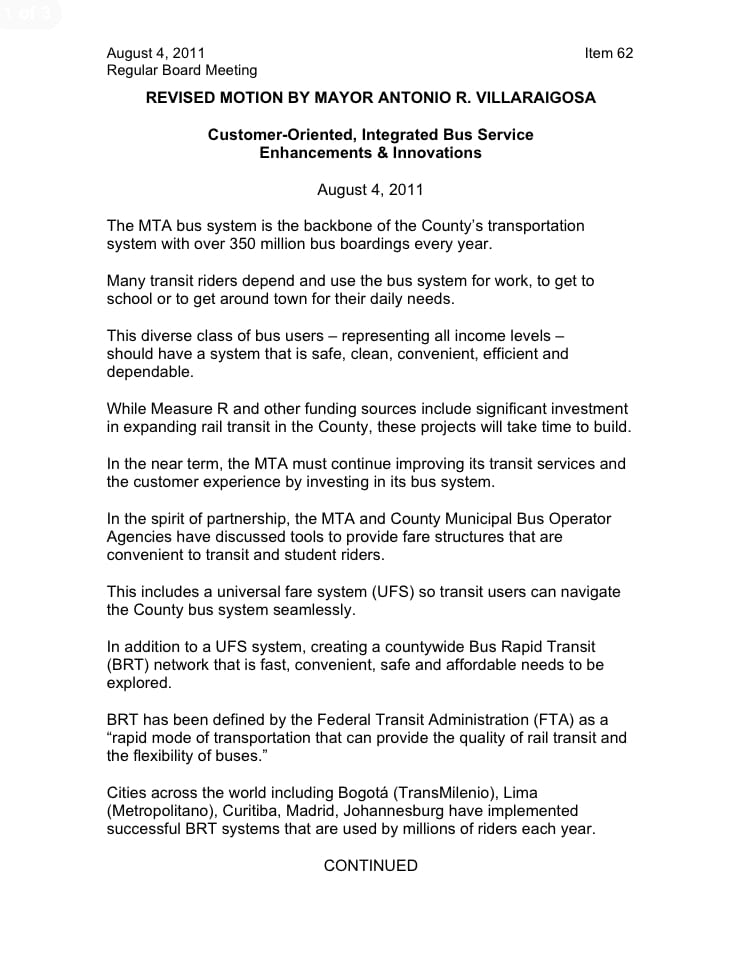
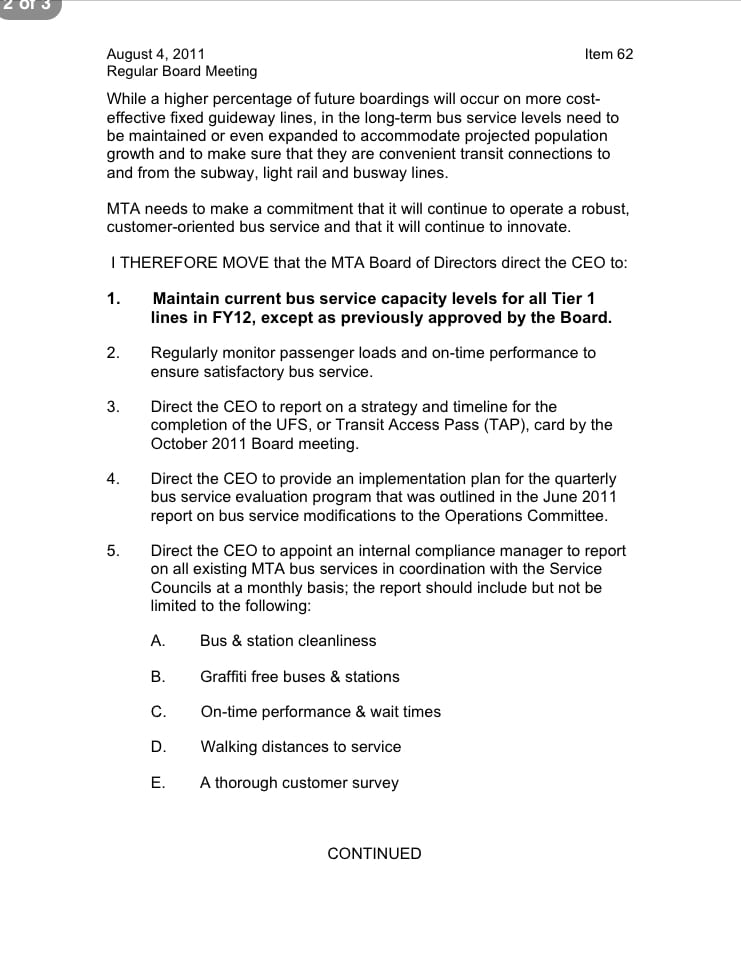
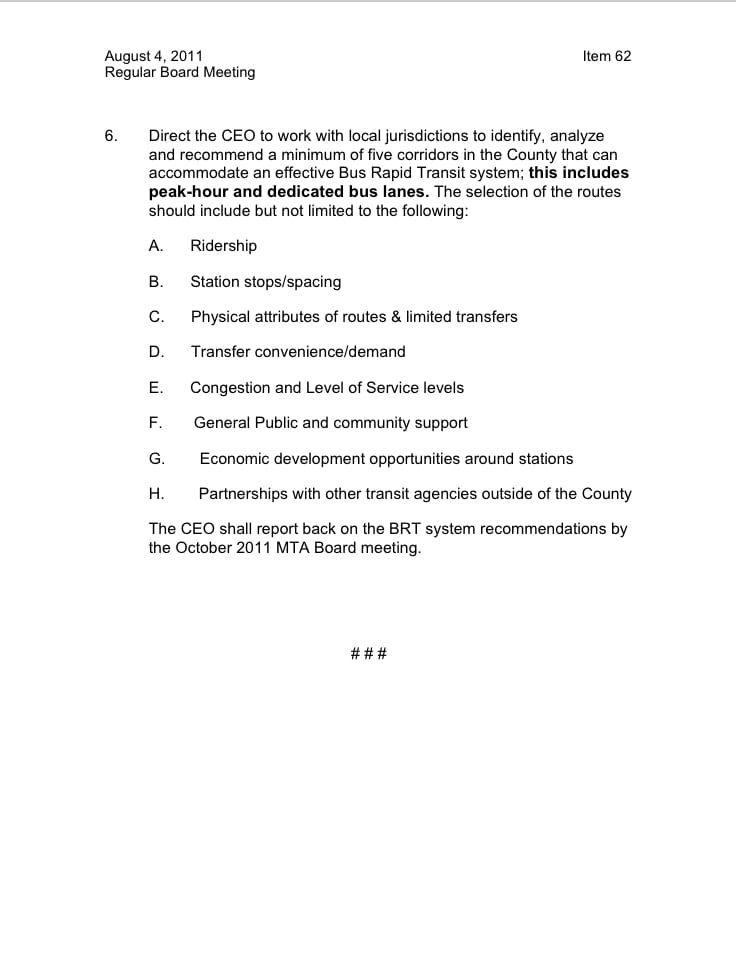
The Metro Board of Directors is meeting tomorrow at 9 a.m. and one of the items to be discussed is the following motion by Los Angeles Mayor and Board Chairman Antonio Villaraigosa.
After several rounds of bus service cuts and changes in the past few years — Villaraigosa voted against the most recent cuts — the motion seeks to prevent cuts to any more “tier 1” lines. Those, generally speaking, are Metro’s busiest bus lines.
The Villaraigosa motion also seeks to expand bus rapid transit in L.A. County, use TAP as the basis for a regional fare system and generate more data on bus ridership.
The discussion, I predict, will involve the costs of some of those goals. Metro is on the verge of beginning construction on several large transit projects funded by Measure R and both state and federal funds for transit operations are declining. The other policy question is whether this data, if generated, will be used or vanish into the ether.
Here is the motion below — click on the pages to see them larger.
Categories: Policy & Funding
BTW, I live and work five miles from home here in LA. I used to pay for those monthly passes until I said forget it. It’s not worth paying $75 every month just to get 5 miles from home and work.
On paper, the monthly Metro Pass sounds like a good deal. In reality, all I had to do was plunk down $300 on my credit card to buy a new bicycle. In four months, I already made up for paying for the bike on what I would’ve been paying for the monthly pass and every month after that is savings for not using Metro.
They can add more service for all I care, but unless they redo the fare system, I’m not paying a ridiculous price for a short ride. In the pizza analogy above, “don’t expect me to pay $15 for a slice of pizza when others get a whole pizza for the same price.” I can just as easily go to another pizza place that charges me a fair price, in this case being my bike.
Add me to the list who questions the basis that Angelinos tend to travel farther so it justifies a flat rate.
I’m from New York. NYC is much smaller than Los Angeles, yet we have to deal with $2.50 flat rate fares across the board. Doesn’t matter if it’s one station away or from JFK-Jamaica to Times Square. This flat rate pay-by-the distance is nothing but total BS for public transit workers to slack off, punish short riders, while they continue to make excuses to ask for more tax payer money because they want to maintain the status quo of not putting in the effort to switch to a distance fare system. Why? Because it’s so much easier to maintain a flat rate system. BTW, it’s also easier to charge everyone $15 for a pizza whether they get only a single slice or an entire whole pizza too! That sure doesn’t make it fair though for the guy who only gets a single slice!
In due time, LA will become exactly like NYC. Everyone ends up paying higher fares, punishing short distance riders AWAY from public transit even more, yet LA Metro scratching their heads why ridership numbers aren’t increasing even though they added more buses or rail. Then they’ll use the excuse for asking for higher sales tax on everything in order to keep public transit afloat because they added so much more to the fleet, just because they DON’T want to put in the effort of charging everyone a fair fare by going distance based.
The people should wake up that this whole flat rate pay-per-ride is a disaster waiting to happen.
@Nancy
The way I see it, it’s a chicken and egg issue because the current fare system alienates short distance riders from using Metro under 10 miles to justify paying $1.50 for shorter rides. And if that 10 mile distance happened to be 5 miles on one bus and another 5 miles on another, we have to pay $3.00 each way. Rather than paying $1.50-$3.00 waiting for the bus for 10 miles, it’s faster and cheaper to just get there on alternate means.
Metro can’t have more frequencies without funding. Yet, Metro can’t continue to rely on more taxes either.
What Metro should be doing is then to re-examine it’s fare policies whether that’s the source of the problem. First they got rid of the transfer system. Then they made us pay $1.50 per ride. All these decisions further alienated shorter distance riders.
Metro needs to go back to the drawing board to review their fare policies to make it more attractive to both short and long distance riders if they want to see ridership numbers increase.
All we ask is that we pay a fair price for the distance we use public transit. It’s nothing different than taking a cab, Metrolink, driving a car or a motorcycle: the shorter the distance the less we pay in cab fares, Metrolink fares, or the cost of fuel consumption on a car or a motorcycle.
I don’t mind the current fare system as it stands, but that’s mainly because I take my bike if I’m only going a mile or two. The thing that concerns me is that it will still take an hour to go a distance of less than 10 miles because of the bus services that have already been cut. We always talk about the bus system in terms of who has to use it. There are a lot of people out there that would like to use it, but cannot justify the two-hour journey. So they drive. And they clog up streets. And they cause traffic, and slow the buses that are actually using the streets down. Then Metro says ridership is low, and cut down on frequency or the service altogether. It’s a bit of a chicken or egg issue.
I don’t think it is fair that Metro assumes everyone will just pay a $1.50. It makes no consideration that people’s travel needs are different from person to person. It makes no consideration that many are also again forced to pay another $1.50 when riding another bus because we got rid of the transfer system. And it makes no consideration for the trip back. For many people that can just as easily become $6.00 a day for a short distance bus ride. Even though day pass is now $5.00, it can feel like a rip-off for many short distance riders. No wonder we see more bicyclists, scooter riders, and motorcyclists these days.
Making that assumption makes Metro no better than the oil companies who think they can charge everyone more for the price of gas and people will continue to fill up their cars them no matter what. And Metro assumes adding more buses is going to get more people to ride? Not with charging everyone $1.50 they ain’t!!
Metro should ask the voters first instead of making decisions themselves. We’re the ones that voted for Measure R, that means they need to ask us about Metro fares.
Is it fair to charge everyone $1.50 even though they only ride it for short distance?
If yes, please explain.
If no, how much should a passenger pay for a mile on a bus?
How much should a passenger pay for a mile on rail?
What method of transportation do you use now for trips under 5 miles? 10 miles? 15 miles? 20 miles?
How much would you be willing to pay for 5 miles? 10 miles? 15 miles? 20 miles?
They need to show us the results to these questions first to back up their claim that everyone is happy with paying $1.50 per ride.
One poster several posts back mentioned how distance fares are to be enforced on buses since it’s so easy to hop and hop off without paying for it.
Simple: if a person doesn’t tap out, the next next time they tap onto another bus it’ll deduct full $1.50 for the previous bus ride. Programming that isn’t hard either.
Tap-in (which everyone does right now anyway) will be the flag that the person rode public transit.
Tap-out will be the flag that the person got off the bus. Everyone will be reminded “don’t forget to tap-out” upon deboarding the bus. Otherwise if they don’t…
Tap-in on another bus will find that the person didn’t tap-out from the previous ride. It automatically deducts the full $1.50 from the previous ride.
By enforcing “don’t forget to tap-out or you’ll be charged the full $1.50,” it’ll still bring revenue to Metro and remind all passengers that if you want to take advantage of lower fares for shorter distances, they have to tap-out upon deboarding the bus.
Cash payers paying flat rate $1.50, TAP card users paying lower pay by the distance fares. The system can be done cheaply with technology today than adding a whole fleet of buses. It gets people moving towards TAP, and it makes transit fares more fair for everyone.
Why wait? Do it now.
Programming [base fare] x [miles traveled] = [fare to deduct so long it’s less than $1.50] should be so easy that it doesn’t even have to be in quarter increments. The base fare could just as easily be done in 10 cents increments just as it can be done it a 25 cent increments. Besides, 25 cents per mile only gets you six miles until the $1.50 cap kicks in. A dime per mile however gets you 10 miles until the $1.50 cap.
Miles traveled can be done simply by running a wire from the TAP machine to the odometer of the bus. Odometer reading at tap-out minus odometer mile at tap-in equals the miles traveled. The concept is no different than a fare meter of a taxi cab.
With GPS-enabled smartphones with NFC chips that are hitting the market today, people could do this today with their smartphones without even needing to buy a TAP card. Open the “TAP app” on Android or iPhone device, the TAP app enables the GPS and the NFC chip tied to a Google account, tap-in your smartphone and it records where you got on the bus, and when you get off tap-out and your smartphone deducts the fare based on the GPS info. If by chance the GPS doesn’t work, the fall back can be the odometer readings of the bus which can still be recorded onto the phone.
You can even create an app that shows your past history on how you rode Metro whose data can be shared with Metro so that they have data where to put express service, increase frequencies and such.
Metro can implement distance based fares relatively easy at a minimal cost across their entire bus fleet with the technology available today. At the same time, Metro can automatically collect hard ridership data from tap-ins and tap-outs that they can use to create a better efficient system.
I see a win-win situation to introduce distance based fares here. This should be seriously considered now.
Perhaps metro could use this as a way to get people to use TAP. Install taps readers on the rear doors of buses and have TAP users with a cash purse TAP into the front of the bus and tap out of the rear of the bus and get charged something like $0.25 per mile, to keep it simple on the TAP programers, with a cap at $1.50. If you pay without a TAP card you get charged the full flat fare. This will provide the discount people have been asking for using TAP cards
Getting more people onto public transit is definitely the highest priority, but in order to do that, they need to rethink their fare system as the current fare policies do not increase ridership from short distance riders. Only then would they have the increase in ridership to warrant the increase in frequencies.
In the end, people care about how much they get for the price they pay. It’s just like buying a can of Coke at the vending machine for 75 cents everyday as opposed to just buying a 36 pack at Costco which comes down to around 35 cents per can. People make decisions based on how much bang they get for the buck, literally.
Public transit should be no different. From the public transit rider, we don’t care about frequencies or what formula Metro came up with to justify the $1.50 rate. We care about how far we’re going to get for the price we put into the fare box. On paper it looks that this $1.50 rate keeps things simple as everyone just pays that fare no matter how far they go.
But in the real world, people make decisions. The bottom line is simple: if I have to pay $1.50 for a mile’s worth of public transit, I’m getting a terrible deal as opposed to another person traveling 20 miles for the same $1.50.
For those who need the Metro bus for a mile, it’s still $1.50 per mile. Any cost conscious person will see that they’d be better off finding alternative means to get to a short destination than riding public transit; moreso if they have to pay another $1.50 to transfer to another short destination, and double that for the way back. People are smart enough to add up “I can pay $3.00/$6.00 day for that short distance ride, or I can just buy a $120 bicycle and pedal to work instead, saving me tons of money down the road.”
Metro would be better off charging a pay-by-the distance rate with a $1.50 cap to start convincing short distance riders to ride public transit. At least that way Metro would have a good data to show public transit ridership is increasing from short distance riders to warrant increase in frequencies on routes that see large ridership.
But increasing taxes to add more buses to the system in hopes that will increase ridership numbers? I have my doubts about that one.
They need to fix the fare system first before any increases to taxes or fare hikes are made.
I’ll add my reasons on why I don’t use Metro for short trips.
I live near Venice and Inglewood and there’s a bus stop there. I do most of my grocery, banking and BestBuy needs at the strip mall on Venice and Overland. There’s a bus stop there too. The distance between the two is 1.4 miles.
Yet, I never use the bus because it’ll cost me $3.00 for that short roundtrip. It’s much easier to cheaper to save that $3.00 bus fare and drive, bike, or walk there. In the end, thats $3.00 that I saved from not taking public transit for such a short ride which instead, could be used to buy a loaf of bread.
Now if that short trip was like a quarter or so, then I’d ride the bus. But for $1.50 each way for 1.4 miles? You gotta be kidding me.
Dear Source Staff
I feel the discussion of Metro’s fare policy is a fairly well discussed topic in the Source’s comment section whenever topics of funding, service cuts, or tap is discussed. I think it would be a good idea to have some articles written about the subject with topics ranging from travel patterns of LA county residents (not just by bus), and a comparisons of different fare structures for different metro systems (bus and rail) around the globe. I feel this will help readers form their own opinions about what fare structure they would like to see implemented here from a somewhat more objective source rather than from a few vocal commentators, myself included.
I think paying less for shorter distances is a great way to get more people use public transit.
It only makes sense that people should be paying less if they ride it for a short distance.
Otherwise people will just drive or find alternate means to get there for short trips to the bank. I’d certainly would use the bus to get to the bank 7 blocks away if it didn’t cost me $3.00 just to get there. Charge me a fair amount for that 7 blocks and Metro will gain my ridership.
I’m sure there are a lot of people who work closer to their homes too. Not everyone lives in the Valley and work in Downtown LA. There is just as many who rents apartment within the city and go to work nearby.
Rather than lose out on customers, Metro should try out charging customers less on a per-distance basis. Bringing in additional 25 cents in revenue on a per-distance fare is much better than losing out on customers because of the charge everyone $1.50 system.
We have the technology available to do this. Metro should try this out to see if paying less for shorter rides will increase ridership. Test it out on the trains first where we already have gates. If it works, move onto the buses just like the Japanese bus youtube video.
I agree. Metro’s fares are prohibitive for short distances.
If Metro assumes that people tend to travel longer distances so it justifies the $1.50 per ride rate, they clearly are out of touch with the people.
Metro is losing out on ridership from those who need it for shorter distances, like me.
Metro can add as much frequencies as they want, but they’re never going to get me on the bus if they expect me to pay $3.00 on two buses for only 6 miles of transit. I can just as easily ride my bicycle for free instead and save the cash for lunch money instead.
If they want more people to take public transit, they need to redo the fare system. It needs to be more fair so that they can gain short distance riders as well as the long distance riders.
Bring back the Rapid 920 Express, please.
First of all cudos to the mayor , all great transit systems have have great rail and great and convenient bus systems.Iwould suggest that if and when bus improvements are made that operators give their ideas.
@Ronny
“It’s Job centers are far apart and a result the typical bus rider in LA most likely travels alot farther”
Why do you make selfish assumptions like that? Did you ask every person in Los Angeles or are those based on empty statistics?
Metro always makes that assumption because all their workers work there. That is so selfish to expect all work is in the urban core.
Sure there’s a lot of people who travel over 30 miles from their home to work. Most likely these are the people running Metro who live far in the rich neighborhood that are being paid with my taxes who only pay $1.50 from their to Downtown LA. They don’t care about the poor person who lives in 103rd St. and has a job at a factory in Vernon who has to pay $1.50 one-way/$3.00 roundtrip for only four stations away.
Y Fukuzawa is right. This $1.50 rate only benefits the rich people living in the suburbs. They say lies like it’ll hurt the poor people that has to travel far, but they never mention about the poor people who live and go to work close by. It makes me wonder if it’s just a rouse to get poor people to pay more while the rich people living off our taxes to pay less for longer distances.
If you expect everyone to keep paying a fixed $1.50 or whatever price increase Metro has mind no matter how close or far our workplace is from our homes, you’re wrong.
We’re not beholden to Metro’s fare prices, their frequencies, or their routes. We have freedom to choose whatever means to get around this city. If it costs less and if it makes sense over Metro, we choose that one. We can walk, bike, buy a moped, carpool, before submitting to paying $1.50 per ride on short trips. Metro will never gain any increase in ridership with this attitude.
You can add me to the “it’s too short to justify taking Metro list.”
I decided to move from the suburbs back to the city because it was getting too expensive to drive from the Valley. So I moved where public transit would serve me best, El Segundo. It has a Green Line station that takes me to Crenshaw.
After a few rides I began to feel that it was a rip-off to pay $3.00 to and from work every day for that short of a distance.
I decided to just decided to buy my brother’s old motorcycle for $1000 and learned how to ride it.
My Yamaha Royal Star is what you call a “gas-guzzling” cruiser. But it still gets 44 MPG, or around 9 cents a mile at current gas prices. For the that price, I can just take the 405 to the 105 for 5 miles to Crenshaw and the fuel cost will only be 45 cents for me. That’s way cheaper than the Green Line. Let alone I can just go when I want whenever I want rather than waiting for the train.
One poster said Metro competes with cars. Yes, that’s because people have a choice. One can pay more in gas to drive a car or save a lot of money on public transit, but that only works for those who have long commutes.
At the same time, one can pay more on public transit or save a lot by walking, bicycling, or riding a motorcycle for shorter commutes as well. No one is sticking a gun to my head that I have to use the Green Line and pay $3.00 to get to/from work from El Segundo to Crenshaw. I have a choice, right?
So my choice was why should I pay $3.00 every day, five days a week totaling $15, when for the same amount I can just as easily pay less than that on my motorcycle? Nope, the Green Line lost my ridership for my commute. My Yamaha gets me there cheaper.
I recently moved closer to my workplace to save on gas. Now I live 4 miles from work.
My new apartment has a bus stop in front of it, but I never see anyone using it. Four of my neighbors work within 5 miles from work. They all drive including me. I then asked why no one takes the bus to work even though the bus stop is right there.
Then we decided to give it a shot and checked Google Transit and we did the math. One person had to get on two buses which totaled $3.00 one-way or $6.00 roundtrip.
Then we then calculated how much it costs in gas to drive on each of our cars at $3.99 a gallon gas. We filled up the tank, rode it for a week, and filled it up again. From the odometer reading, the price we paid at the pump and how much we filled up, we were able to calculate the cost of driving our cars. We came out to around 16-22 cents a mile depending on the type of car we rode.
At 16-22 cents in gas per mile at a 5 mile distance, it cost us anywhere between 80 cents to $1.10 for a five mile trip. Compare that with $1.50 to $3.00 one-way, taking the bus was more expensive than driving. If gas prices rise, we’ll just bicycle to work.
@ Y Fukuzawa
Its cost per passenger MILE and the figure is $0.68
That number is derived by the cost metro has budgeted to operating its vehicles divided by the estimated number of miles passengers are expected to travel that fiscal year. I am not sure how metro gets the passenger mile figure but im pretty sure its based on historical ridership data collected by the agency.
here is the budget if you want to take a look at your self
http://www.metro.net/about_us/finance/images/Proposed_Fiscal_Year_2012_Budget.pdf
I don’t think metro would follow your logic and simply add a bus and assume more ridership would be generated, the capacity on a particular route must be pretty high before a bus is added on to service.
The formula you present here is still lacking some information
(cost to run public transit) / ((passenger 1 riding from A to B)+(passenger 2 riding from A to C)….)
the cost to run public transit is dynamic as seen by the different cost effectiveness of the various types of services i mentioned a few post ago. How do you price the system, do you average out the entire cost of operations for the entire system and use that as the basis for the pricing scheme or do you charge different prices for the bus and the rails systems with the rail riders being charge a lesser rate per mile than bus riders since its cheaper to move someone on rail than by bus since it would more fair to charge on the latter.
You also keep decrying that flat fares are a sin of public transportation. Yet tokyo itself has a bus service that operates on a flat fare system.
http://www.kotsu.metro.tokyo.jp/eng/services/bus_ride.html
Look, I think you have made valid arguments for implementing some semblance of a distance base fare system. But I don’t think this should be metros top priority at the moment because I sincerely doubt their will a be huge surge of riders using the service for short trips especially when the are other pressing matters
Service is not frequent enough especially on some lines connection to the rail/brt system.
The travel times necesarry to get from one end of town to the other is still much much longer on public transit than it is by car even during rush hour unless you happen to live within reasonable access to a rail station and it can be used effectively in your commute.
The bus system is unreliable with on time performance being somewhere around 70-80%. This needs to improved.
TAP is still far from being complete with the lack of transit operators such, as Metrolink, and Santa Monica Big Blue pass to make regional travel much more easier.
As well as daily capping
LA is a sprawling city unlike New York, London, and Tokyo. It’s Job centers are far apart and a result the typical bus rider in LA most likely travels alot farther than in the other aforementioned systems and a result would pay more now if unsubsidized distance based fare system were implement. Metro needs to build and fixed guideway network and the cities of the region have to increase density around them in order to make transit more cost effective.
The region has several transportation issues caused by decades of poor urban planning that cannot be fixed by just swinging the magical business wand that somehow will fix everything.
Im done. I said all I am going to say of this matter. I doubt I convinced you, you seem really dogmatic about this issue.
Pay by the distance fares with a maximum cap of $1.50 sounds like a great idea that can benefit TAP users and hopefully convert more people to use TAP.
Why not try this out on the Metro Rail where there’s already a TAP Here/TAP Aqui fare gate?
Cash payers pay a flat fee of $1.50. TAP users pay a variable rate based on distance ranging from whatever to a maximum of $1.50.
I work at a McDonald’s 3 miles from home. Every money I make has to help the family.
To get to work on the bus, I have to use 2 bus because there’s no 1 bus to work.
I can’t pay $1.50 every bus to get to work and come back to home. That’s almost an hour’s work of pay.
I can buy a $5.00 daily pass or $75 for a monthly pass to save money, but I just ride my bicycle to work instead.
Only time I use Metro is when I go far. For 3 miles, it’s not worth the money.
Metro needs to make transit cheaper for short rides if they want more riders.
@Ronny
I’d like to see what mathematical formulae Metro used to come up with that number because I doubt it costs Metro $0.68 per passenger.
In order to get that figure, you need to divide the cost of running a bus with an number of passengers.
i.e.
$6800 to operate a bus / 10000 passengers = $0.68 per passenger
So Metro figures if 20000 passengers start riding the bus, the cost goes down to $0.34 per passenger?
Let’s look at Metro’s more frequency formula.
$13600 ($6800 x 2) to operate two buses / 20000 passengers = $0.68 per passengers.
But Metro assumes adding another bus will increase ridership to 25000 passengers. Therefore
$13600 / 25000 passengers = $0.54 per passenger.
Ooh, look, see!? More buses means lower cost per passenger, more revenue for us! FTW!!!
DEAD WRONG. What’s the basis of ridership increase? They’re not adding passengers from short distance riders like me and several posters here because it doesn’t add up.
In reality it’s becoming more like
$13600 / 8000 passengers = $1.70 per passenger for making transit suck for shorter distance passengers
What the true cost of ridership should be
(cost to run public transit) / ((passenger 1 riding from A to B)+(passenger 2 riding from A to C)….)
Anyone in business could figure this out.
@Ronny
The same can be said with street trams in Amsterdam; it’s easy for anyone to hop on and off without catching it, but they manage zone based fares through use of the OV Chipkaart. Tap-in upon boarding, tap-out upon leaving. OV Chipkaart deducts proper fare.
Japan has been running distance based fares on buses since the 1970s before GPS and tap ‘n go systems were the norm. I remember it because I grew up on it.
This is how distance based fares work for buses in Japan:
http://www.youtube.com/watch?v=qEO32tc323o
http://www.youtube.com/watch?v=qhKr-EHGc1E
Nowadays with technology, most people in Japan just tap-on from the back and tap-out from the front and the card deducts the proper fare. One-way barriers are installed on the stairwell in the back so that no freeloaders can “jump the bus.” The only way out of the bus is from the front, in plain view of the bus driver.
See what can be done if TAP gets it right?
1. Copy distance based fares for buses just like Japan. Metro should just watch the youtube video.
2. All wheelchair passengers board from the back of the bus and pay the fare to the bus driver anyway so it’s shouldn’t be difficult to have everyone board the bus and tap in.
3. Upon deboarding the bus, tap out. TAP deducts proper fare anywhere from $0.10-$1.50 max. Daily cap should also be set so that TAP doesn’t deduct more than $5.00 on a single day as with the day pass.
Metro does none of these because it’s “too difficult.” No duh it’s much easier to tax everyone. But I’m sorry, I don’t see it that way, taxing is not the answer to solve all of Metro’s problems and flat rate $1.50 is not getting me on buses for shorter distances as with some of the others who’ve posted here.
I’d like to see Metro do this first before come crying to me for more tax hikes and more flat rate transit fares.
@ Y Fukuzawa
You also keep not acknowledging the cost per passenger mile for bus figure ($0.63) that I keep mentioning from Metro’s Budget. Your five mile trip under this scenario would cost $3.15 one way or 6 dollars round trip. That sounds a lot higher than the current day pass
@ Y Fukuzawa
I think its delusional to think that frequencies don’t matter. If a bus were scheduled to come once every hour or once every 30 mins (as many buses in LA county currently do especially in the off-peaks) the $0.10 per mile fare is not going to get me to my destination any faster than walking much less driving.
And how would you enforce running distance based fares on buses. With a rail system you can install barriers or have authorities located at the stations but with a bus its easily for person to hop and hop without paying their fare before anyone even gets a ticket.
Just look at SF MUNI
http://www.youtube.com/watch?v=ca0FfrejvAw
Metro earns no ridership from me either.
I live near Hauser and Pico and I work at the Beverly Center. The distance is only 2.7 miles.
I tried the bus and from the route given to me by Google Transit, my choices were:
A. Walk to San Vincente and ride the 550 Metro Bus and pay $1.50 each way, costing me $3.00 roundtrip, taking me 22 minutes not including the wait time for the bus.
B. Take the 5 or 705 Metro bus to La Cienega and Pico, transfer to the 105 bus to Beverly Center, costing me $3.00 one-way, $6.00 roundtrip, taking me 26 minutes not including the wait time for the bus.
Forget it, I’m going back to the car. It only takes me 7 minutes and it won’t rip me off $3.00 to $6.00 just to go to work for 2.7 miles. If you want me to get me back on the bus, it has to become cheaper than this!
Am I the only one who remembers when Metro was right on the eve of implementing distance-based fares on the Blue Line in the ’90s? Yeah, that went over well.
@Y Fukuzawa
You hit it right on the nail.
My primary bank is 7 blocks from my home. There’s a bus stop right near my home and right in front of the bank. But I never ride the bus because it’ll cost me $3.00 for that roundtrip. It’s faster and cheaper to drive to the bank than pay $3.00.
You want me to get on a bus, they need to make it cheaper because I only need it for that 7 blocks to the bank.
When looking at a distance based model, one needs to look at it at both ends, not just the long distance rider. There’s also the short distance rider as well.
Metro’s goal is to increase ridership. Great, let’s shoot for that goal. How? Their answer is increase more frequencies.
My answer is just the opposite; make transit fares fairer. Right now, the $1.50 flat rate only conveniences long distance commuters and doesn’t capture short distance riders.
To us, we don’t care if more frequencies are added; we’re still going to drive cars, ride the motorcycle or scooter, pedal the bicycle or walk for short distances than paying $1.50 for a short ride on the bus.
Metro isn’t gaining our ridership, it fails to earn our revenue, we’re not going to pay $1.50 everytime we ride a bus for such a short distance no matter how much frequencies are added. If I only ride the bus for a short distance, I expect to pay less than those that ride it longer.
As it stands now, Metro is not making me ride pay $6.00 roundtrip for a 7 mile distance between home and work as it is now; it’s cheaper for me to ride my 5 cents per mile 70-80 mpg scooter instead.
Metro is not making me get on the bus to pay $6.00 roundtrip to my local movie theater 5 miles away. I just ride my bicycle.
Now if they make it fair so that I pay less on a distance based model, then they gain whatever fair amount they wish to pay me. But no way am I paying $6.00 roundtrips just to get me to work (7 mi) or to the movie theater (5 mi).
@Ronny
They’re not making it worthwhile for shorter commuters to take public transit even if they increase frequencies.
Put yourself in a poor person’s shoes. She needs to go from Wilshire/Western to Wilshire/Vermont. Every paycheck she earns matter to her. Do you think she’s going to pay $1.50 for the 1 mi trip between Wilshire/Western to Wilshire/Vermont? No, she’s probably just going to walk. She doesn’t care if more frequencies are added, to her, it’s still $1.50 for a mile ride; a rip-off.
Metro loses out on her passenger ridership because they charge a flat rate $1.50 no matter how short/far ride system.
Now let’s implement a distance based fare where it costs 10 cents per mile with a max cap of $1.50. Will Metro gain her ridership? Likely so, because now she pays only 10 cents for that 1 mile ride instead of $1.50 for a mile ride. And she can go as far as she wants, to the relief that it won’t cost her more than $1.50.
She gets on at Wilshire/Western tap-in, gets off at Wilshire/Vermont tap-out, 10 cents deducted from TAP. Metro now earns 10 cents extra revenue from a person that previous chose to walk over paying a rip-off $1.50 for a short ride.
@ Y Fukuzawa
I sincerely doubt metros fare structure discourages short distance trips. Lack of high frequency bus system is more of a killer in my opinion
Besides I mentioned that under metros current bus operations cost per passenger mile is close ($0.68)
so the 1.50 you pay essentially covers 2.5 miles on the scale of what I would consider a short trip.
I also believe you are making the lack of distance based fares more of an issue than it really is. I have mentioned before the much revered Tokyo transportation system has distance based fare rail system and a *GASP* FLAT FARE bus system. From what I can guess flat fares are ideal for short trip local bus travel and distance based fares are ideal for longer trip fixed guide way travel.
The biggest problems facing metro right now are a lack of fixed guide way systems that encourage long distance travel and a high frequency bus system that encourages short trip travel. The distance base fares are more of a non-issue until the regional connector comes online when longer distance commutes will be possible on the system.
@Ronny
How do you expect Metro to increase ridership if the current model penalizes short distance riders? It doesn’t capture the short distance transit rider market because the cost doesn’t justify paying such a price for such a short distance.
How do you a person going from his home to the local movie theater to take public transit over the car? How do you get a family of four to take public transit to the local mall in the weekend? How do you get a group of friends to dine out to a nearby restaurant without driving there? How do you get a group of beer buddies to get to a local bar?
All of these short distance activities are not cost efficient when one has to pay a flat rate $1.50 fare, let alone transfer to another bus to pay another $1.50. Add the transit needed back, it costs $6.00 just to get nearby? Forget it, the car is cheaper.
If I live in West LA, do you expect me to go all the way to Hollywood to watch a movie? No, I’ll go to the nearest one, which is only 5 miles away. But taking public transit it requires me take two buses, but I’m not going to spend $6.00 on the bus just to get to/from there. It’s cheaper and faster to take the car, my scooter, or ride my bicycle there instead.
Now if they introduced distance based fares where that 5 mile ride only cost me $1.00 (or $2.00 roundtrip), then I’d consider it. But paying $6.00 for 5 miles in each direction? No way.
@Ronny Rueda Where are the Silver Line statistics?
I’m with Y Fukuzawa on this. The fare system is totally out of sync with how people really move about in this city.
At current gas prices, I average 20 cents a mile on my V-6 engine Mitsubishi Galant. Under 7.5 miles, it’s cheaper to drive than take public transit, let alone I have to transfer to another bus at an intersection. Current fare structures will not make people use the bus or rail for shorter distance trips, only long distance commuters benefit.
How is Metro going to get people to get out of their cars if they don’t make it beneficial over the car for shorter distances?
@ Y Fukuzawa
This is data from Metros 2012 budget
the estimated operating cost per passenger mile for the following are
Red/Purple $0.38
Light Rail $0.53
Orange Line $0.87
Bus System $0.63
A few things come to mind when I see these figures.
1) $1.50 bus rider covers essentially a 2 1/2 mile bus ride.
2) If I were to implement distance bases fares on the Rail System and the Orange Line the average operating cost per passenger for all three systems would be about $0.59. So the 22 mile trip from 7th/Metro to Long Beach Transit mall under 100% farebox recovery would cost close to $12.98 one way
3) Higher Ridership reduces operating cost. The Red Line is the least expensive system to operate per passenger mile ( I heard the blue line cost $0.24 per passenger mile but I can’t verify that) due to to its high ridership on a relatively short distance.
This makes me conclude that perhaps its more important for Metro to find ways to increase ridership on its existing services than it is to switch to a different fare model right now. Higher ridership means lower operating cost, lower operating cost can be passed on to riders as fares in the future.
[…] Is Mayor Planning to Increase Bus Service in the Next Year? (The Source) […]
@calwatch
I’d like to see statistics first that say majority of poor people tend to travel longer distances before throwing out the “it penalizes poor people” argument.
There’s no tap in/tap out data that shows how majority of public transit riders in Los Angeles travel.
What’s the percentage of low income Angelinos that travel end to end from Santa Monica to Downtown LA? What’s the percentage of low income Angelinos that travel end to end from North Hollywood to Downtown LA?
If demographic says otherwise, poor people tend to live closer to the urban core in LA rather than live out in the suburbs.
Real statistical data might as come as a s shock that poor people ARE PENALIZED NOW with the current structure because they tend to PAY MORE over a SHORTER distance.
But flat rate fares are much easier to administer and don’t penalize the poor who pay with their time when they travel long distances, since public transit is slower than driving. Even the Expo Line or Blue Line will be slower than driving the 18 hours of the day there isn’t heavy traffic.
@Ronny
Because public transit in its current flat rate model only benefits longer distance commuters and not short distance commuters. Not everyone lives and works 30 miles or more, there are just as many who lives and work within a 10 mi radius.
In it’s current $1.50 flat rate model with no transfer, it only benefits those that live far away to make commuting on public transit a deal. For those that live and work closer to home, public transit doesn’t work; we end up paying more for a shorter ride; the car, motorcycle, scooter, moped or even bicycling makes more financial sense than public transit.
Take me for example. My commute from home and work is only 7 miles. Yet, if I were to take Metro, I’d have to take two buses costing me $3.00 one-way or $6.00 per day.
It’s not like TAP has a daily cap system so I’m forced to go through the hassle of buying a daily pass for $5.00 to save a buck. Or, I could buy a 30 day pass for $75, with no guarantee those 30 day passes will have any price increase in the future.
Furthermore, I still have to wait for the bus to arrive, which makes it unreliable for a person to get to work on time.
Or, I can ride my 125cc scooter which gets 70-80 mpg and it only costs less than $4.00 a week to fill up the tank. Even if gas prices went up to $10/gal, I still will end up paying cheaper on my scooter than flat rate public transit.
This is why flat rate fees makes no sense; Metro loses out on capturing shorter distance commuters.
I also want to clarify that I do support distance based fares. Once the regional connector is in place it will be hard to justify the current fare structure. But its completion date is not set for another 10 years and many projects are expected to be completed before then (Expo Phases I and II, Crenshaw/LAX, Foothill Gold Line, Orange Line Extension, and some Metrolink upgrades) which will increase ridership and potentially altering the transit mode share in the region. So metro would not be committing political suicide by changing to that fare structure.
I’m sure problary the busiest Metro routes would get service would get preserved but service increases aren’t likely happening especially with the bad economy. Plus remember this is a “possibility” and we should wait and find out to see what happens.
IMO, I think Metro should risk of expanding service since I think it’s fine the way it is.
Rather service is bad or not, it’s still better then no bus.
@J P I wouldn’t mind if Metro raises their fares to $2.25 or even $2.50, same fare is San Diego MTS. I rather pay higher fares then hear some annoying Transit TV on the buses. I have been avoiding ride the Metro buses a lot.
However I like the Municipal Transit agency (other Transit Agency, non-Metro) in LA better.
@Y Fukuzawa There is not gonna be a Metro Boat to Catalina Island, there no plans for it. I think there’s already a ferry between them by private companies.
As for your other comments, I disagree with the ideas especially the 3 options for ballot.
@Redebbm I disagree with your ideas, the only thing I will agree is about the TAP Cards being complicated which I even think it’s a failure and I’m not fan of Smartcards. I prefer using the EZ Pass better.
@ Y Fukuzawa
Public Transportation does not compete with cars?
This article begs to differ
http://hr.blr.com/HR-news/HR-Administration/Commuting/Nearly-90-Percent-of-Workers-Drive-to-Work-Most-Dr/
The data is a bit dated but I doubt too much as changed. People will fork over money for cars as long as they are more convenient than public transit
Gas will become a non issue in terms of car finances if the electrical vehicle can establish itself in the automobile market. Their is plenty of coal to power these puppies
The Success of London and Tokyo’s transit system has less to do with distance based fares and more to do with government funding system expansions and upgrades to make it a viable alternative to the automobile. Something being seen less and less in this country
And you forgot the fourth option
4. No new taxes, or fare increases/changes
Extremely popular among those who would like Metro to operate only within its current budget and those who represent the BRU.
@Ronny
“It would also be unfair for Metro to reduce its dependence on tax subsidized while still competing with a HIGHLY subsidized CAR INFRASTRUCTURE”
This is what I get confused about. What makes you think public transit competes with cars in this day and age?
People pay more for gas, parking, insurance, maintenance, and have to deal with traffic jams than ever. Just because Metro implements distance based fares doesn’t mean everyone’s going to jump back on the bandwagon to drive cars again.
Even if you implement distance based fares, it’s still beats the cost of owning and maintaining of a car, the hassle of sitting in traffic, and paying more for ever increasing fuel and insurance prices.
Why do you think they work in London and Tokyo?
See, you all say you want Metro to become like London and Tokyo, yet you don’t want to copy their fare structure.
It’s either:
1. More taxes for everyone
2. Increase in flat rate fares for everyone
3. Scrap it and go distance based
This should the type of ballot measure that needs to be made.
@Y Fukuzawa – You know, you use the boat thing to try and make what you think is a valid point about extravagance in public transportation, but Boston’s MBTA has boat and ferry service, and they seem to get by just fine. Why should it cost a hundred bucks to get back and forth to Catalina? Oh I know, so some private entities can reap serious profits, the greatest moral imperative of them all.
@Conner hits it on the head. Increase Frequency on lines. I feel like there are many lines in communities, that need the service, that are lagging behind on ridership because of 45-60 minute headways (Not to mention how early in the evening they end) not the other way around as Metro argues. Especially, when that bus connects to a Metro Rail station it can be frustrating to see these station be underused. Metro should target stations in communities like Highland Park or East L.A. and make better transfers and connections so the reach of these stations captures more ridership, rather than just capture those who live in the immediate vicinity. Also VASTLY improve the biking connections. It can be difficult for cyclists to reach stations because the streets around them are just not equipped properly.
On TAP, redo it. NOW. It’s become too complicated, for passengers and even bus drivers to use. TAP/Metro needs to call The people who manage The London Oyster Card, or at the least the Bay Area’s Clipper. Copy word for word what they do. And apply it here. We have the technology. Use it!
Perhaps the most important improvement to buses that can be made is to increase the frequency to 15 minutes or less especially on buses that connect to rail lines and busways. Frequency is key in attracting ridership, currently metro rail and the orange line bus operate at good frequencies but most often the respective bus connections at most stations seem to have headways of more than a half hour (except maybe rush hour on weekdays). This means people cannot rely on making their last leg/ first leg connection of their trip and end up driving instead due to the inconvenience and wasted time of long waits for connections.
@ Y Fukuzawa
The day metro moves away from flat fares should be the same day ALL of LA County’s Freeways are operating on congestive pricing. Congestive Pricing after all is the BUSINESS solution to the traffic problem that most of the world has implemented. It would also be unfair for Metro to reduce its dependence on tax subsidized while still competing with a HIGHLY subsidized CAR INFRASTRUCTURE
Actually, if they charged a $2.00 flat fare and allowed free transfer between different lines (and got rid of zonal fares), I’d be all for it.
And how does Metro plan to institute this under the current fare structure? More taxes; gee let’s hike the sales tax to 15%? Higher flat rate bus fares, gee let’s hike flat rate fares to $2.00?
While at it, I’d like to have a Metro boat to Catalina Island for a $2.00 fare too!
Again, it shows you how Metro and our local government has no business skills what so ever. Have a problem? Tax everybody!
I remember when the Rapid service first started and the stops were nice and had real-time arrival information. Now, the Rapids are just glorified limited stop lines. No ammenities, no information, nothing. Metro just let them decline. Same thing would happen with any BRT. It will be new and fancy for a little bit and then Metro will neglect it.