
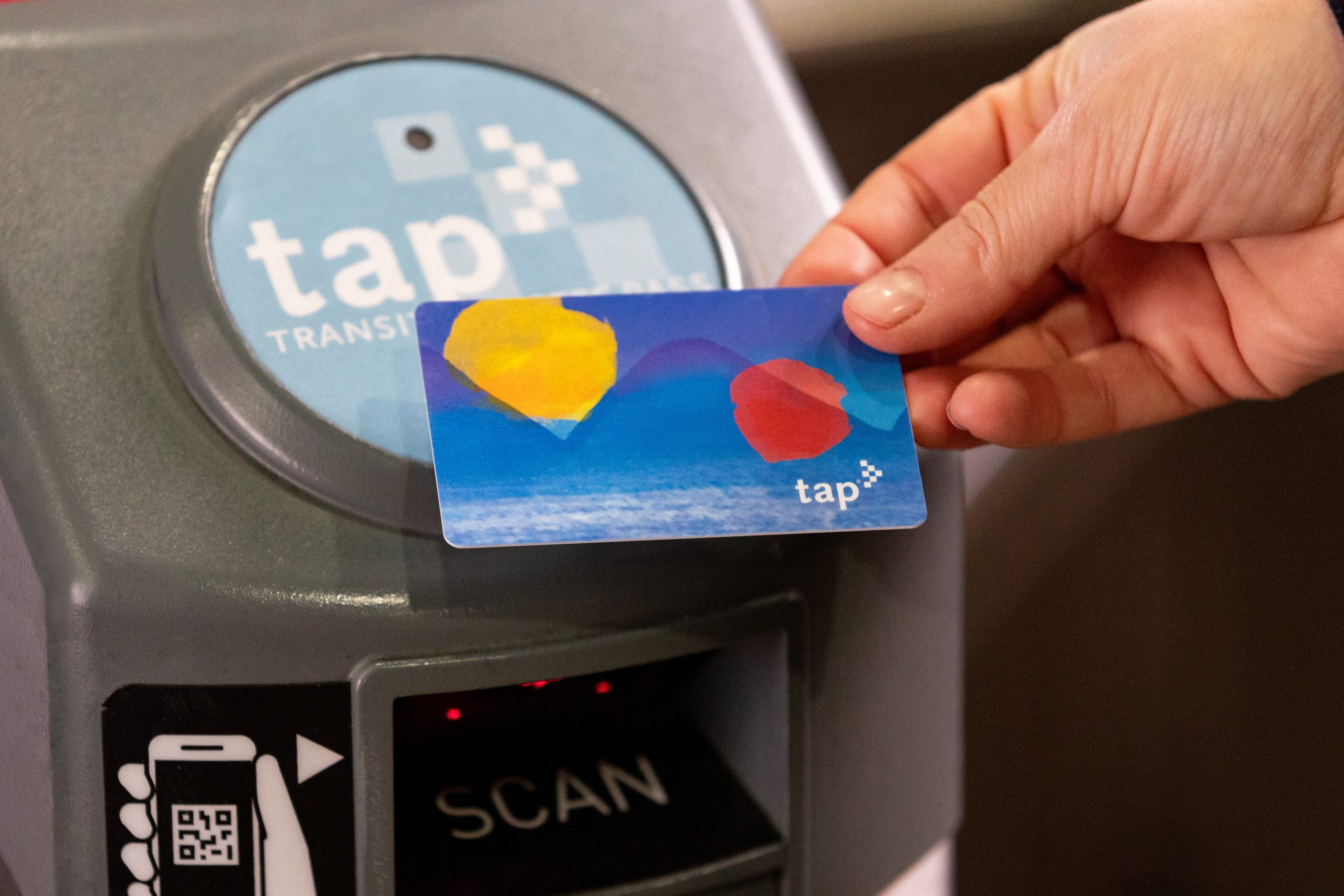
Our TAP-to-Exit pilot program is expanding to the E Line’s Downtown Santa Monica Station on Tuesday, Sept. 3.
The TAP-to-Exit program is where riders must tap their fare cards when exiting at stations. The goal is to increase fare compliance and to ensure that our system is used for legitimate travel needs by our customers.
Three things for riders to know:
- If you tapped your card and fare was deducted when you started your trip, tapping out will confirm fare was paid and open the fare gates.
- If you did not tap your card when you started your trip, your fare will be deducted when you tap out at the turnstiles.
- There will be a 7-day grace period before citations are issued to riders who do not have a valid fare.
We will have plenty of staff on site at Downtown Santa Monica to help riders purchase the correct fare and to answer any questions. There will also be staff from our Low Income Fare Is Easy (LIFE) program to help riders sign up for our reduced fare program that provides unlimited free rides for the first 90 days and then 20 free rides each month to qualified riders.
We launched TAP-to-Exit at the B Line’s North Hollywood Station in May. In the time since, we’ve seen a notable increase in the number of customers paying fare, as well as a drop in crime and other issues reported by riders via Metro’s Transit Watch app.
We surveyed customers at NoHo Station since we launched the pilot and found 91% reported feeling the station was cleaner and 86% thought it was safer.
The expansion of TAP-to-Exit is part of several public safety initiatives approved by the Metro Board of Directors at their July meeting. After TAP-to-Exit is implemented at Downtown Santa Monica Station, we’re going to expand the pilot to our other end-of-line stations. Dates for that expansion are to be determined. Please stay tuned to The Source and our social media for updates.
In addition to TAP-to-Exit, there were three other initiatives approved by the Board in July that we think will continue to improve public safety and make riding our system more comfortable:
•We’re expanding our Elevator Open-Door pilot program from 21 elevators to 57.
Keeping the doors open when the elevators are not in use helps discourage illegal or unwanted activity in the elevators.
During this pilot, we’ve found that riders with strollers and bikes are having an easier time using the elevators — no more having to race closing doors. Equally important: we’ve also seen a drop in the number of times our cleaning crews are summoned to clean up big messes.
•We’re going to expand our smart restroom pilot program at up to 64 stations over the next four years.
In addition to our traditional restrooms at Union Station and several other locations, we launched our pilot restroom project last fall by partnering with Throne, a start-up firm that manufactures and operates restroom units that can be accessed via a code sent to cell phones. Throne restrooms — complete with running water and lights — have seen over 75,000 uses across 10 stations so far. The feedback we’ve received has been very positive.
Lack of restrooms on our system (and other transit systems) has been a long-standing rider complaint, and traditional public restrooms have often been subject to inappropriate activity that create new issues by trying to resolve one. We’re pleased to be testing a quick-build, scalable solution that so far is offering our riders restrooms that are clean, comfortable and safe.
- We’re going to pilot weapons detection systems at two rail stations starting later this year.
Although we believe very few overall riders carry illegal weapons, we don’t want any weapons on our system that could jeopardize your safety. We believe the presence of these detection units will serve as a deterrent and discourage individuals from bringing weapons onto our system.
Categories: Transportation News
Forget about fare enforcement. It doesn’t matter when the train cars and stations are always flooded with food waste, sticky floor, urine, feces, or all of the above.
Remember 2003 when the Gold Line was first opened, that everything was pristine and it was actually enjoyable to ride?
It is very sad to see Metro Rail has become the way it is today.
YOU SHOULD ONY TAP WHEN YOU ENTER !! THIS IS TOTAL MADNESS NOW
did you not READ the article? If you tapped (paid) when you entered all you have to do is TAP when exiting and it won’t CHARGE you.
I consider this another step in Metro controlling it’s passengers.
The majority of riders do pay their fare. Leave them alone.
Boycott METRO NOW.
This does absolutely nothing as fare evaders and disgusting homeless ppl will just cruise to the next stop where even more “police” will continue to look the other way and nobody will be checking for diddly squat. Besides, most of the fare evasion, craziness and all of the murders have been on BUSES!!!!! I see nothing but chaos and filth day after day.
I like the idea of weapons detection
Will the tap out charge a fare if it’s been 2 hours and 1 minute since I started the trip? Or is it programmed differently than when entering a station (2-hr transfer).
Are you allowed to put in a few quarters for an one way fare? This was a problem in the past when you couldn’t top off a fare. You have to put in the full amount of a new one way fare whether you like it not.
What about fare evasion on buses? With all-door boarding this is likely to get worse. In New York City, almost half of the bus riders don’t pay. I wonder what it is here?https://www.nytimes.com/2024/08/26/nyregion/nyc-bus-subway-fare-evasion.html?smid=url-share
Peop;e are using the emergency exit @ NoHO and bypassing the whole concept without tapping. So it defeats the purpose.
Yet I just saw a load of security telling people to kick rocks. Even saw one arrest as well recently.
But I will admit, there has on occasion been people going through the gates with the cops not saying anything, and after 8pm security is almost non existent throughout the system, but it is deterring those that would otherwise just hop the gates.
I’m certain it’ll start working in Santa Monica.
Downtown Long Beach is screwed long term though. You are talking about a complete redesign of access to the station itself before installing fare gates.
With the loop design in Downtown Long Beach, the new system may not be able to be implemented as it works elsewhere.
Norwalk, Redondo Beach, and East LA should be easy to implement. Might as well wait for Pomona to be the new A north terminus before instead of doing it at Azusa now. Similarly, have this in place at La Cienega instead of Western. With the transfer possibilities, Union Station & Expo/Crenshaw may be challenging.